
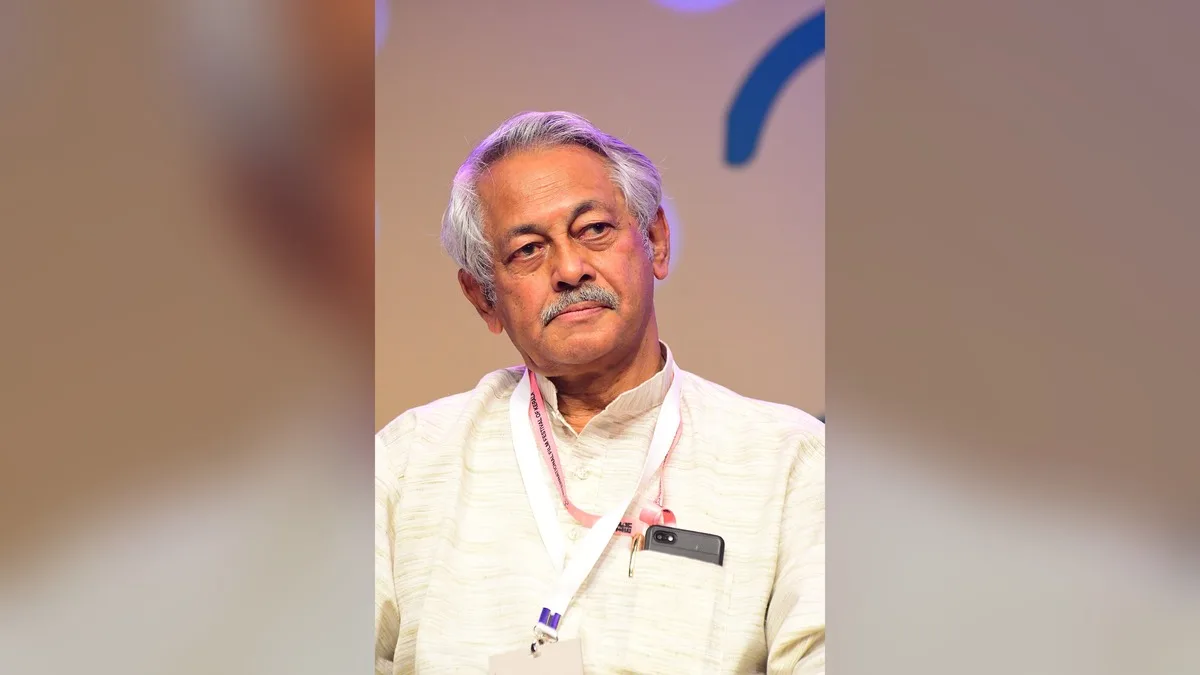

Girish Kasaravalli spoke in Goa about half a century of filmmaking. He kept arriving at the same word. The 75-year-old Kannada-language director led a masterclass at the 57th International Film Festival of India. It was titled “The Moral Universe of Parallel Cinema: 50 Years of Girish Kasaravalli.” His summary of five decades of work was blunt: “All my films talk about othering.”
Girish Kasaravalli Discusses the Theme of ‘Othering’ in His Films
He said it in answer to a question about “Ghatashraddha,” his 1977 Kannada classic about religious orthodoxy and social exclusion, and whether it still speaks to contemporary India. His reply covered far more than one film.
Kasaravalli told the audience he always returns to how society looks at certain people through a different lens and, in doing so, turns them into outsiders. He called that the biggest cruelty one person or group can inflict on another.
Run the list and the thread holds. “Ghatashraddha” in 1977. “Tabarana Kathe” in 1986. “Thaayi Saheba” in 1997. “Dweepa” in 2002. “Gulabi Talkies” in 2008. Variety described the question running through all of them. How do societies exclude individuals and communities? And how do people who are victims of oppressive structures end up helping to keep those structures alive?
That second half is the uncomfortable part. Kasaravalli has spent 50 years refusing to let the excluded off the hook simply for being excluded.
Girish Kasaravalli spoke at a masterclass during the 57th International Film Festival of India.
Variety’s Asia editor Naman Ramachandran moderated the session at IFFI in Goa. According to Variety, the conversation moved between the moral contradictions of society and the link between cinematic form and social content.
Exclusion is rarely a single dramatic act. Kasaravalli’s films keep showing it as something closer to habit, a lens a whole community agrees to look through. Families do it. Villages do it. Couples do it to each other in smaller ways, deciding early who someone is and then reading every later action through that verdict.
Kasaravalli Highlights the Political Nature of Cinema
Kasaravalli was asked whether he considered himself a political filmmaker. Kasaravalli’s answer, as Variety reported it, was that anyone who makes a film, mainstream or art cinema, is making a political statement. Either it supports the dominant ideology or it opposes it. He said a filmmaker cannot avoid that choice.
He went further. There is no such thing as only entertainment, he said. Entertainment is itself a political form.
Neutrality, in his telling, is not on the menu. Staying quiet about who gets pushed out is a position too.
Kasaravalli on Characters, and Why He Compared Them to Buying a House
Kasaravalli also spoke about the people inside his stories. He told the audience he does not want any of his characters to become a mouthpiece for a particular ideology.
Drawing on Jean-Luc Godard, he compared understanding a character to buying a house. Variety reported his point: you look at it from the outside first, then from within, and only then make a judgment.
Most people buy the house from the pavement. They see the facade, hear what the neighbours say, and decide. Othering, the thing Girish Kasaravalli has filmed for 50 years, starts exactly there, with a verdict delivered before anyone has stepped through the door. Partners do this to each other after one bad argument. Families do it to the relative who left. The judgment arrives first and the inside view NEVER gets its turn.
Kasaravalli’s method runs the other way. Outside, then inside, then judgment. At 75, after “Ghatashraddha,” “Dweepa” and “Gulabi Talkies,” he is still insisting on that order.
Sources: Variety