

Emotional availability isn’t always easy to spot, especially when you’re too invested in the relationship. You might find yourself hitting a wall with your partner, feeling like there’s something amiss, but not quite able to put your finger on it. Recognizing the signs that he is emotionally unavailable can save you from endless frustration and heartbreak. It’s time to face the music and see what’s really going on.
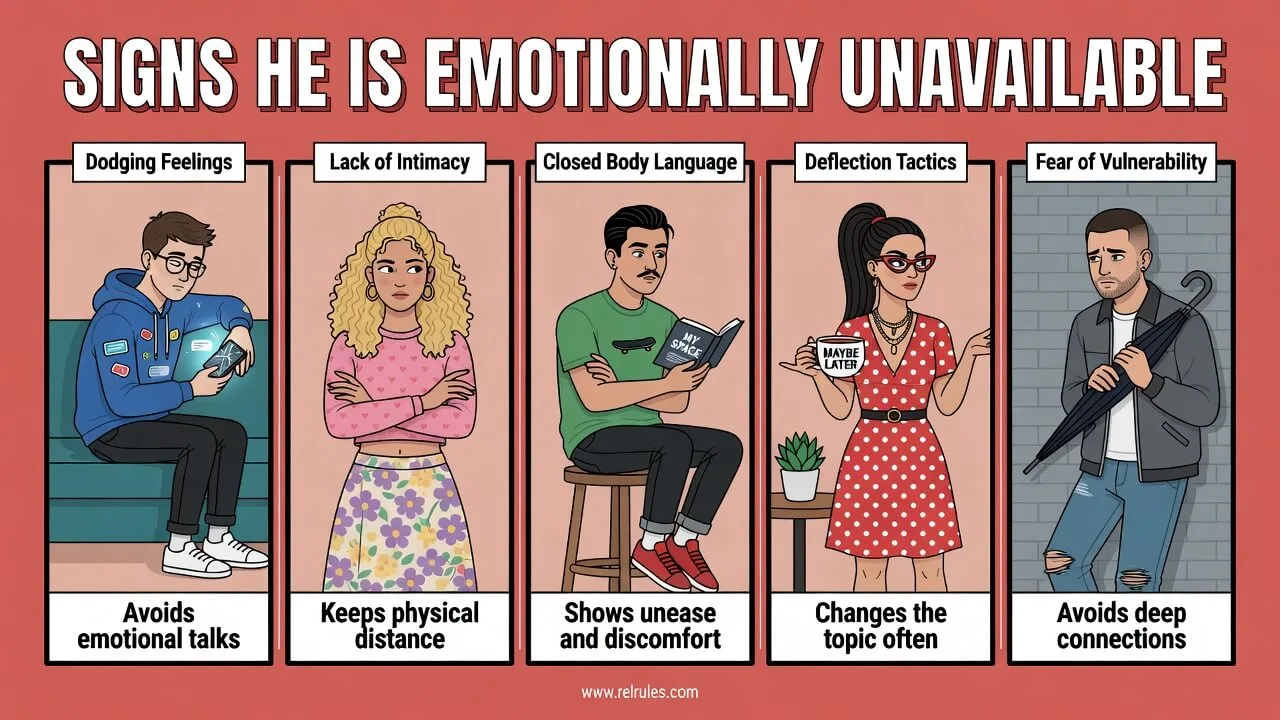
1. He Dodges Conversations About Feelings
He is emotionally unavailable if he’s constantly dodging conversations about feelings. You bring up how you feel about the future, and suddenly he changes the subject to something trivial. You ask about his day, hoping to hear more than just the surface details, but he shuts down any attempt to dive deeper. You start to notice this pattern, where every meaningful conversation is met with deflection or evasion.
Your partner might believe that discussing emotions makes him vulnerable, a state he’s not comfortable with. He might have learned from past experiences that showing emotions leads to pain, so he keeps his guard up. This behavior leaves you feeling isolated, as if your emotional needs are a burden rather than a priority.
Confront the issue head-on. Tell him you need open communication in the relationship. Use specific examples of when he dodged conversations and express how it made you feel. If he values the relationship, he’ll make an effort to engage more deeply. If not, you’ve learned something crucial about where you stand.
Silence doesn’t solve anything. It only postpones the inevitable.
Your partner’s eyes dart around the room every time you bring up a topic that matters. You catch the subtle shift in his posture, the slight tightening of his jaw. He is emotionally unavailable because talking about feelings makes him vulnerable, and vulnerability isn’t his comfort zone.
He tells himself that emotions complicate things, believing that logic and practicality should prevail. His upbringing taught him that emotions are messy, and he’s internalized that lesson. He fears that opening up will expose him to judgment or rejection.
2. He Keeps You at Arm’s Length
Keeping you at arm’s length is a classic behavior of an emotionally distant partner. You notice that intimacy is limited; he’s there physically but emotionally absent. Plans are often vague, and commitments seem like they’re always up for negotiation. The moment you try to get close, he finds ways to create distance.
Your partner might be afraid of losing control. Getting close means opening up, and that’s a risk he may not be willing to take. He maintains this distance to protect himself, not realizing it leaves you feeling unwanted and undervalued. You might even start questioning if it’s something you did, though it’s more likely his internal struggle.
Call it out directly. Tell him you feel a gap and want to understand what’s causing it. Ask if there are specific fears or concerns that make him hesitant to get closer. Be clear that maintaining this distance could mean the end of the relationship. Decisions need to be made.

Walls don’t keep pain out. They keep you in.
You reach for his hand during a quiet moment, but he pulls away ever so slightly. It’s not a blatant rejection, but a subtle reminder that you’re not as close as you thought. He keeps a safe distance, ensuring you don’t get too comfortable with the idea of intimacy.
His mind is a fortress, fortified by past experiences that taught him that closeness equals risk. Letting someone in feels like handing over the keys to his heart, and he’s not ready to give you that power. Trust is a currency he’s not willing to spend easily.
3. His Past is a Locked Box
When his past is a locked box, it often means he’s not ready to share himself fully with you. Every time you ask about his family, old friends, or past relationships, he dodges or gives you the bare minimum. It’s as though parts of his life are off-limits, leaving you with an incomplete understanding of who he is.
Your partner may have unresolved issues or traumas he’s not ready to confront. He might fear judgment or vulnerability that comes with exposing his past. This secrecy creates barriers, preventing the relationship from growing into something deeper and more meaningful.
Approach this carefully. Let him know you want to understand him better and that his past is part of that understanding. Ensure him that you’re not there to judge but to support. If he remains closed off, consider what that means for your future together.
You can’t build a future on hidden foundations.
Questions about his past are met with vague answers or a change of subject. He guards his history like a sacred text, only revealing the chapters that paint him in the best light. The rest remains locked away, hidden from view.
His past is a landmine of memories, some painful, some he’d rather forget. He believes that sharing those pieces of himself might change how you see him. The fear of being judged for past mistakes keeps him silent, a prisoner of his own history.
4. He Avoids Defining the Relationship
If he avoids defining the relationship, it might indicate he’s not fully invested. You’ve been together for months, yet every time you bring up where things are headed, he skirts the issue. He is emotionally unavailable, content with the ambiguity, leaving you in a constant state of uncertainty.
Your partner might enjoy the benefits of the relationship without the responsibility that comes with commitment. He likely fears being tied down and losing his freedom. To him, defining the relationship would mean accepting obligations he’s not ready for.
Ask him directly what he wants and expects from the relationship. Be clear about your own needs and boundaries. If he’s still unwilling to have that conversation, you need to question if this is the right relationship for you.
Ambiguity isn’t a safe place to live.

Your partner skips around the topic of commitment like it’s a minefield. Every time the subject comes up, he deflects with humor or changes the subject. It’s not that he doesn’t see a future with you; it’s that defining it feels like stepping into a cage.
To him, labels mean limitations. He fears losing his freedom, associating commitment with restriction rather than partnership. His mind races with scenarios of what he might have to give up, overshadowing the potential joy of what he could gain.
5. He Disappears When You Need Support
Disappearing when you need support reveals a lack of emotional availability. You have a rough day and reach out to him, but he’s nowhere to be found. When life gets challenging, you find yourself facing those challenges alone, as he retreats into his own world.
Your partner might not know how to handle emotional situations. He could feel overwhelmed or inadequate, leading him to avoid the situation entirely. This leaves you feeling unsupported and questioning his commitment to being a true partner.
Express your need for support clearly. Let him know that being there during tough times matters for the relationship. If he continues to disappear, it might be time to evaluate if this is a partnership or a solo journey.
Support isn’t optional. It’s essential.
You turn to him in moments of distress, seeking solace, only to find an empty space where he should be. He retreats into his world, leaving you to fend for yourself. It’s not an intentional abandonment; it’s his way of coping with pressure.
He believes in being self-reliant, thinking that everyone should handle their own emotions. His upbringing taught him that seeking support is a sign of weakness, so he disappears, hoping you’ll understand that his absence is his way of respecting your strength.
6. He Prioritizes Everything Over You
When everything else seems to take precedence over your relationship, it’s a red flag that you might be dealing with an emotionally detached partner. You notice that work, friends, and hobbies always seem to come first. You’re left feeling like an afterthought, wondering where you truly stand in his life.
Your partner might be using these distractions as a way to avoid confronting his feelings for you. By staying busy, he keeps a safe distance from emotional commitments. He may not even realize the impact this has on you, as he’s caught up in his own world.
Address it directly. Tell him you feel secondary and that this isn’t sustainable for you. Make it clear that a balanced relationship requires prioritizing each other. If he can’t make that shift, you need to decide if you’re willing to stay in the shadows.
You’re not an option. You’re a priority.
Your partner’s schedule is a carefully orchestrated symphony where you’re just a background note. His work, hobbies, and friends all take precedence, leaving you feeling like an afterthought. He is emotionally unavailable, assuring you that you’re important, but his actions sing a different tune.
He convinces himself that providing for the future is how he shows his love. His logic is that by focusing on other priorities, he’s securing a stable life for both of you. He doesn’t see that his absence in the present speaks louder than any future promise.
7. He Can’t Handle Your Emotions
If he can’t handle your emotions without becoming defensive or shutting down, you’re likely facing a significant emotional barrier. You express your feelings, and he immediately becomes defensive, as if your emotions are an attack on him. He might even dismiss your feelings altogether, leaving you feeling invalidated.
Your partner might lack the emotional maturity needed to navigate complex emotional landscapes. He may not have learned how to engage with emotions constructively, viewing them as a threat rather than a natural part of a relationship.

Communicate the importance of emotional engagement. Let him know that dismissing your feelings isn’t an option. If he is emotionally unavailable and continues to invalidate your emotions, consider whether this is the kind of emotional landscape you want to invest in.
Your feelings are valid. They deserve space.
Your partner stands like a statue as your emotions pour out, unsure of how to react. His hands remain idle, his face a blank canvas. It’s not indifference; it’s confusion about how to navigate the storm of your feelings.
He tells himself that emotions are best left unspoken, fearing that engaging might exacerbate the situation. The belief that emotions are volatile and unpredictable keeps him from stepping into your emotional world. He’s not avoiding you; he’s avoiding the unknown.
8. He Shuts Down After Arguments
After arguments, if he shuts down rather than working through the conflict, it’s a sign that he may not be equipped to deal with relationship challenges. You notice that disagreements end with silence instead of resolution. Days pass, and nothing is addressed, leaving a lingering tension.
Your partner might view conflict as a threat, something to be avoided at all costs. Shutting down is his way of maintaining control or preserving peace, not realizing it only creates more distance. This pattern stunts the growth of the relationship, leaving issues unresolved.
Address this pattern. Insist on resolving conflicts rather than letting them fester. Make it clear that ignoring problems won’t make them go away. If he continues to shut down, you need to ask yourself what kind of future this holds.
Unresolved conflict is a ticking time bomb.
Your partner retreats into silence after every heated exchange, a wall of quietude rising between you. He shuts down, processing the argument internally, leaving you to wonder what he’s thinking. He’s not punishing you; he’s trying to regain control.
He tells himself that silence is the best way to prevent further conflict, hoping that time will heal the rift. He fears that speaking too soon might reignite the argument, so he chooses silence as a shield. What he doesn’t see is that silence can be just as loud.
9. He Moves at a Snail’s Pace
Moving at a snail’s pace in the relationship could be a deliberate choice by him to keep things superficial. You notice that milestones are delayed or ignored altogether. He seems content with the status quo, showing little interest in progressing the relationship.
Your partner might be afraid of commitment or change. By keeping the relationship at a standstill, he avoids confronting fears of the unknown. This leaves you feeling stuck, questioning if things will ever move forward.
Confront the slow pace head-on. Ask him about his vision for the future and express your own. If he’s unwilling to budge, you need to decide if you’re willing to wait indefinitely.
Stagnation isn’t a plan. It’s a stop.
Your partner moves through the relationship at a glacial pace. Every step forward is met with hesitation, every decision analyzed to the point of paralysis. His cautious approach feels like a test of your patience.
He believes that rushing leads to ruin, that every decision must be weighed and considered. His fear of making the wrong choice paralyzes him, trapping him in a cycle of inaction. He doesn’t see that his slow pace may cost him what he values most.
10. He Makes You Feel Insecure
Feeling insecure in his presence often indicates that he’s not nurturing the emotional connection you crave. You find yourself questioning your worth, wondering if you’re good enough. His actions or lack thereof leave you feeling like you’re not a priority.
Your partner might not realize the impact of his behavior. He might be so caught up in his own world that he overlooks your need for reassurance and validation. This neglect fosters insecurity, making you second-guess the relationship.
Communicate your feelings of insecurity. Make it clear that you need more emotional support and validation. If he dismisses your concerns, you need to evaluate if this is the emotional environment you want to be in.
Your worth isn’t defined by someone else’s neglect.
Your partner’s offhand remarks leave you questioning your worth, a nagging insecurity creeping in. He doesn’t mean to hurt you, but his words cut deeper than he realizes. You’re left wondering if you’re enough.
He convinces himself that honesty is the best policy, unaware of how his words echo in your mind. He believes that transparency fosters trust, not realizing that his delivery can undermine your confidence. His intention isn’t to wound, but the impact is undeniable.
In Short: In Short: If you’re feeling frustrated in your relationship, it might be because he’s emotionally unavailable. This article highlights key signs, like dodging deep conversations and keeping you at arm’s length, helping you recognize the red flags that could save you from heartache.
Talk to Me
Which of these signs hit hardest for you? Tell me in the comments.
You can identify if he is emotionally unavailable by observing his communication patterns and willingness to engage in deeper conversations. If he consistently avoids discussing feelings or keeps you at a distance, these are strong indicators. Additionally, if he struggles to share personal thoughts or make commitments, it’s likely he is emotionally unavailable.
Common signs that he is emotionally unavailable include dodging serious conversations, maintaining physical presence without emotional connection, and avoiding intimacy. You may notice that he rarely shares personal experiences or feelings, which can create a sense of isolation in the relationship. Recognizing these patterns can help you understand his emotional state.
Change is possible, but it often requires self-awareness and a willingness to address underlying issues. If he recognizes that he is emotionally unavailable and is open to communication, he can work on becoming more emotionally available. However, this process takes time and effort from both partners.
Men may become emotionally unavailable due to past experiences, fear of vulnerability, or societal conditioning that discourages emotional expression. They might have learned to associate emotions with pain or rejection, leading them to build walls around their feelings. Understanding this can help you approach the situation with empathy.
If you realize he is emotionally unavailable, it’s important to communicate your feelings and concerns openly. Share specific instances where you felt a lack of emotional connection and express your need for deeper communication. If he is unwilling to work on these issues, you may need to reassess whether the relationship meets your emotional needs.